


The startup process
This iteration process has only one goal; to create a startup which business model is:
-
Scalable, that is to say that it can reach a critical size and still perform well while undergoing more pressure from growing demand, working capital, manufacturing etc.
-
Repeatable, meaning that the startup can find patterns that will allow it to sell the same product at the same price to different customers.
-
Profitable. To be sustainable, a business has to generate enough positive net profit to pay for wages, working capital, loans, and growth.
To increase its chances of success, a startup should go through 4 key steps:
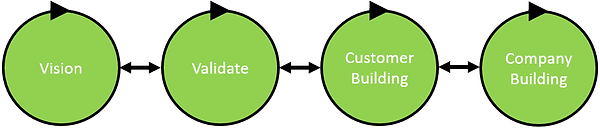
A startup begins with the vision, where a founder or a set of cofounders believe they have found an idea for a new company. At this point, this vision is not a company since it does not have any revenue or staff. It is however with this vision that the entrepreneur(s) will start to make assumptions that they will test and try to validate through the process just described. Those assumptions will comprise all the elements of entrepreneurs' Business Plan from target market, to product features, necessary funding, revenue sources, etc.
If part of the business model is not validated through an experiment, the entrepreneur should go back to its Business Plan and iterate with a new experiment according to feedback. A great tool to help you keep track of all assumptions is the Business Plan Canvas, discussed in the Creating a Business Plan section. Common questions to ask when going through the validation process are mainly:
-
What would have to be true for my assumptions to be viable?
-
What effective and cheap experiments could I run to test my assumption(s)?
Out of the validation process, entrepreneurs should have a business model that is scalable, repeatable and profitable. If not having both (vision and validation) after a year, the tentative entrepreneur should maybe consider giving up.
Customer building is when the startup, in its validated definition, goes into market. It is no longer a small experiment but rather a full scale launch of the startup's product, using all it has learnt along the validation process. However, this is when everything goes wrong, and is also an iterative process. Entrepreneur(s) may realize that it is more difficult than expected to get customers to buy the company's product, or that the trigger to incremental sales lies in a feature entrepreneurs did not think of. The Business Plan should still remain flexible enough to allow refinements along the way.
However, entrepreneurs should not be demoralized as it is by solving these problems that the startup will get into the last phase of the entrepreneurial model, Company Building. While increasing sales, the startup will need more structure, or in other words, more capabilities, more employees, or new partners as it grows.